Master Genshin Hironishi: The Historic Interview on Budo, Competition & Shotokai
A landmark historical interview with Master Motonobu Hironishi on the origins of Shotokai, Yoshitaka Funakoshi's innovations, why Gichin Funakoshi strictly prohibited sports competition, and the profound difference between traditional Budo and modern sport
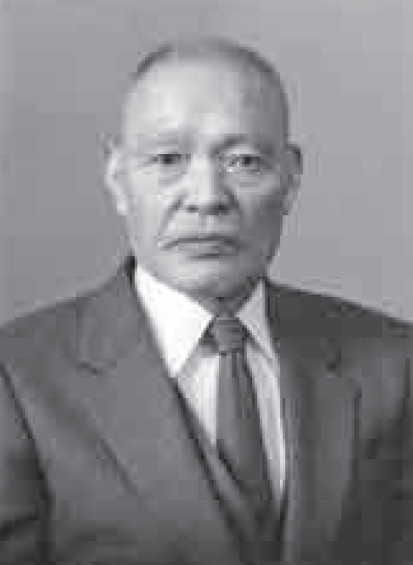
Master Motonobu (Genshin) Hironishi (1913–1999) • Direct disciple of Gichin Funakoshi, chief collaborator of Yoshitaka Funakoshi, and long-standing President of Nihon Karate-do Shotokai.
Master Motonobu Hironishi on the True Spirit of Karate-do
Originally published in the historic Boletín de la Asociación Karate-do Shotokai de España (Madrid). Master Motonobu (Genshin) Hironishi (1913–1999)—direct disciple of Supreme Master Gichin Funakoshi, closest research collaborator of Yoshitaka “Gigō” Funakoshi, Shihan of the Chūō University Karate Club, and long-standing President of Nihon Karate-do Shotokai—offers rare, firsthand testimony on the evolution of modern karate, the spiritual hazards of tournament competition, and the inner biomechanics of Shotokai.
Master, where and when were you born?
I was born on January 1st, 1913 in the city of Kyoto.
When did you begin your karate practice?
I began practicing Karate-do in 1931 at the age of nineteen, at the Waseda University Karate Club in Tokyo.
Who were your primary classmates and instructors?
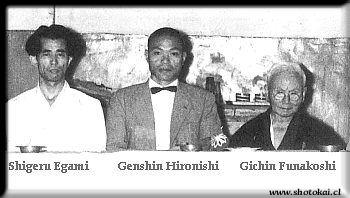
My closest senior companions were Shigeru Egami and Hiroshi Noguchi. Master Gichin Funakoshi served as our supreme Shihan, and Takeshi Shimoda served as his primary assistant instructor. Later on, after Shimoda’s untimely death, O-Sensei’s third son, Yoshitaka (Gigō) Funakoshi, took over technical leadership. I also remember that around that time Masatoshi Nakayama was training at Takushoku University, with whom we crossed paths occasionally.
How did the lifelong friendship between yourself and Master Shigeru Egami emerge?
I cannot pinpoint the exact moment, but from our very first days of practice there arose a spontaneous, unspoken communication between us—a deep sense of unity that extended far beyond the dojo into our everyday lives. This harmony was perhaps nourished by our contrasting constitutions and temperaments: Mr. Egami was lively, nervous, and intensely spirited, whereas I was naturally calmer and more deliberate. We balanced each other perfectly.
We have heard that in your youth you won first prize in a nationwide physique competition organized by the Asahi Shimbun newspaper. Could you recount that?
Yes. In those youthful years I possessed an extraordinarily robust and muscular constitution. Following comprehensive physical and medical examinations under the medical standards of that era, the medical board selected me as Japan’s prototype model of ideal physical development.
Could you speak about the origins of Karate-do, its early status in mainland Japan, and its subsequent transformation?
Before its national dissemination, karate was a strictly minority art practiced in secrecy. When it was first introduced to Tokyo from Okinawa in the 1920s, Japan was immersed in intense nationalism. Because karate had arrived from an isolated island prefecture, it was initially viewed with condescension and regarded as inferior to traditional Japanese arts like Judo and Kendo.
After extensive historical research and travels abroad, we came to understand that throughout Buddhist and Asian martial traditions, disciplines with comparable characteristics have always existed: systems that seek ultimate spiritual truth through arduous bodily cultivation. These martial practices maintained an intimate symbiosis with spiritual philosophy.
In primitive antiquity, tribal survival struggles gradually refined specialized combat movements before they were introduced to Okinawa. The great modern transformation of this heritage was spearheaded by Master Gichin Funakoshi and his son Yoshitaka, in close collaboration with their most devoted disciples.
What were Master Gichin Funakoshi and his son Yoshitaka like in person and technique?
The Old Master was slightly below average height, but possessed an extraordinarily serene, benevolent character and an unwavering, gentle disposition. He was a quiet, modest gentleman who found joy in composing Chinese classical poetry and practicing calligraphy; his demeanor was always that of an intellectual and a sage.
Technically, however, his tsuki (thrust) was remarkably devastating and his uke (blocking) immensely heavy—a reality we experienced with acute physical pain whenever we attacked him in practice.
Yoshitaka, his third son, had a formidable, passionate character. Technically, he was an absolute genius yet uncompromisingly orthodox; his karate was characterized by relentless, dynamic offensive initiative and superhuman energy.
What relationships existed historically between Masters Funakoshi, Mabuni, and Miyagi?
Today those historical associations belong to memory. In that golden era, eastern Japan centered around Tokyo practiced Master Funakoshi’s karate, while western Japan centered in Osaka practiced Master Kenwa Mabuni’s style (Shito-ryu). Because Mabuni was considerably younger than Funakoshi, he held immense filial respect and reverence toward O-Sensei. Master Chōjun Miyagi (Goju-ryu) centered his primary sphere of influence in Okinawa.
Before World War II, a national martial arts demonstration was held annually in honor of the Emperor. Master Funakoshi was the only karate pioneer granted the supreme honor of performing before the Emperor not once, but twice. It was through these historic presentations that Karate-do achieved universal respect and national recognition across Japan.
How did competition begin in Karate, and what was Master Funakoshi’s actual position on tournaments?
Originally, as an experimental pedagogical tool to showcase the possibilities of karate, a free-sparring format (jiyū kumite) was developed strictly for technical research and public demonstrations. Over time, however, this sparring format began shifting in spirit, drifting far from the ethical core of Budo.
In 1940, Master Funakoshi formally prohibited it. In 1941, he ratified this prohibition with absolute uncompromising severity, warning his students that anyone who took part in competitive matches or championships would face immediate and permanent expulsion from his school.
In those pre-war years, rabid militarism was driving the country toward total conflict, and the social atmosphere was intensely aggressive. Master Funakoshi was determined to keep his disciples insulated from that bellicose, egotistical mindset.
Between trusted fellow students and as a method of clinical technical research, he allowed partner training, but never with the degenerate goal of winning awards or trophies. And in any case, that pre-war sparring between senior students was incomparably harder, heavier, and more demanding than what is seen in modern tournament karate.
What is the relationship between Shotokan and Shotokai?
Shotokai is the association founded by Master Funakoshi and his senior alumni to organize and preserve the authentic method of his teachings. Before World War II, this association included more than 90% of all karate practitioners across mainland universities. Today, Shotokai remains the only entity in the world possessing the explicit authorization and legal bequest of the Funakoshi family to administer and represent the historic SHOTOKAN dojo name and heritage.
Why did separations and schisms occur within the school after the war?
The primary catalyst was the desire of certain instructors to commodify Karate-do into a Westernized competitive sport.
Amid the deep social confusion during and after the Second World War, new commercial organizations emerged, capitalizing on the appetite for modern American-style competition. These formats easily attracted the postwar youth through the immediate gratification of tournaments and trophies—a spectacle that was very much in vogue under the cultural shifts of that era.
Master, could you explain what Shotokai seeks, and what constitutes its defining technical characteristic?
Shotokai seeks strictly to follow the ethical and martial path mapped out by Master Gichin Funakoshi, placing paramount emphasis on the spiritual reality of Do (the martial way).
Technically, because Shotokai officially abstains from sporting tournaments, strikes and kicks must have the depth to penetrate after contact. All techniques are founded on natural, continuous, and heavy body momentum, with the focal point centered on energetic compression at the hara (the lower abdomen) and the capacity to adapt spontaneously against multiple opponents.
Could you explain your authentic concept of Kime?
For a technique to possess genuine kime, it must be capable of transmitting living kinetic energy forward through the target. If a technique relies on rigid muscular contraction, the kinetic momentum is arrested at the surface—therefore, we do not consider such stiffness to be kime.
We cultivate the release of deep internal energy, not merely superficial muscular tension. Because of an optical illusion, true internal power is not flashy or theatrical to an untrained eye. It is certainly easier to execute movements with tight muscular contraction, but in doing so, the living energetic flow is severed.
Master Funakoshi consistently taught that in Karate-do there must exist a harmonious equilibrium between tension and relaxation. Unfortunately, contemporary tournament styles seek only tension and stiffness.
People conventionally assume that when contact is made, the blow has ended. In reality, the moment of contact is precisely when the blow begins. Shotokai utilizes the unified kinetic mass of the entire body, propelled from the hips. To understand this in one’s own flesh requires many decades of continuous training.
What is the fundamental difference between traditional Budo and modern sport?
The Chinese ideogram Bu (武) etymologically signifies “to stop the clashing halberd”—to bring about peace. This must be understood as the profound pursuit of non-opposition. That was why Master Funakoshi insisted upon transitioning from Jutsu (combat technique) to Do (the ethical way)—acting in complete accordance with nature, adapting to its laws, and uplifting human character. In Budo, technically, one replaces the violent attack with non-attack.
In sport, athletes are conditioned exclusively to secure victory. In Budo, one must teach the wisdom of transcending defeat. This by no means implies passively letting oneself be beaten; rather, it means transcending the childish dualism of winning and losing. It means purging the ego—which is the only path to becoming truly unified (“one”) with the opponent.
In Japan there is an old adage: “To yield is to conquer” (負けるが勝ち, makeru ga kachi). In true Budo, when you receive a blow, you should feel genuine gratitude, because your partner has illuminated a weakness and taught you a profound lesson.
In competition, rules must be invented to prohibit dangerous techniques, exactly like military peacetime maneuvers where artificial constraints are imposed within an enclosed ring—forgetting that in actual crisis there are no rules and one may be attacked from all directions. The paradox of competition is that everything prohibited by sporting rules is precisely what is most vital in real combat; I dedicate myself to practicing what the tournament rules forbid.
In a ring, you only pay attention to what is right before your nose. If you consider what is behind you, it is a waste of time. In Western Boxing, fighters stand erect because low blows are illegal; in karate tournaments, because low kicks to the joints are prohibited, the guard creeps up because fighters know they are safe down below. In Budo, where awareness must remain total and unbroken, posture (kamae) is fundamentally different.
Look at sports Judo: bouts often begin with static collar-grabbing, ignoring the reality of being struck before that distance, entirely omitting the study of ma-ai (distance and timing). In classical Kendo, the ancient stance was deep and evasive (kokutsu-dachi); today, sporting rules have raised the posture, and low cuts are eliminated. Formerly, a sword cut was executed obliquely through the torso using the whole body weight; today, competitors tap the helmet lightly to score referee points.
In any ordinary sport, a referee merely enforces rules. In sport karate, however, judges arbitrarily award points and decide winners. From sporting matches to real martial survival, every single principle is completely reversed.
What does Karate-do mean to you personally after a lifetime of practice?
As the decades pass, my love for Karate-do only deepens. As I grow older, I comprehend its dimensions with greater profundity and humility.
When I first stepped into the dojo as a young man of nineteen, I simply wanted to become strong so I could fight. In time, I came to realize that very little technique is required merely to fight in the street.
Most young beginners enter the dojo with that same instinct: they want to be formidable and powerful. Instructors must respect that natural youthful drive, but guide and educate them patiently. With time, sincere training, and maturity, the true spiritual meaning will naturally reveal itself.
Who were your primary disciples over the years?
I can say with quiet satisfaction that the vast majority of the great master instructors who lead Shotokai across Japan and internationally today trained alongside me on the tatami at one period or another throughout their journey.
What technical and spiritual level have you observed in Shotokai Karate-do in Spain?
I am genuinely surprised and deeply moved to feel that everyone possesses such an earnest desire to learn and progress. I have witnessed a level significantly higher than I had expected. It has brought me immense personal satisfaction to observe non-Japanese practitioners practicing with such sincerity and profound martial spirit.
I also observe that Karate-do in Spain is in a state of vigorous, healthy evolution; consequently, there are no fundamental qualitative defects to correct. I am fully confident that with the pure dedication and enthusiasm I have seen across all practitioners, the standard of practice will rise even higher in the near future.
What final counsel would you impart to all sincere practitioners of Karate-do?
I would urge every practitioner to remember that within the daily practice (keiko) of Karate-do, the ultimate goal of Budo must always be the attainment of the spirit of non-opposition, non-attachment, and non-profit (mushotoku)—striving unceasingly toward inner harmony, peace, and universal unity.
We should strive to develop the relationship that exists between a mother and her child: even when a toddler strikes his mother’s arm in frustration, her heart holds no hatred or resentment toward him.
Among immature men, when an exchange does not hurt, there is calm; the moment pain is felt, anger and retaliation flare up immediately. Observe instead the spirit of wise grandfathers with their grandchildren: they are gentle, kind, and condescending because of their deep maturity and boundless understanding. True mastery knows no offense.
Therefore, the foundational purpose of training is nurturing genuine human relationships, enduring friendship, and mutual elevation. As one matures technically, one’s entire outlook on life is transformed.
In Shotokai, the supreme, lifelong crucible is the dedicated practice of Kata. Human beings are inherently burdened with petty attachments, vanity, and destructive habits. The more sincerely and deeply you immerse yourself in Kata, the more completely you liberate yourself from those weaknesses and discover lasting peace.
“Within the daily practice of Karate-do, the supreme aspiration of Budo is to attain the spirit of non-opposition and non-profit (mushotoku)—striving unceasingly toward harmony, self-mastery, and spiritual unity.”
— Master Motonobu Hironishi (1913–1999)