Stances of Karate-do — Shizen-tai and Foundational Postures
The classical stances bequeathed by traditional masters: natural stance (Hachiji-dachi / Shizen-tai), closed-foot stance (Heisoku-dachi), attention stance (Musubi-dachi), parallel stance (Heiko-dachi), and reverse natural stance (Gyaku hachiji-dachi)
Stances • Shizen-tai and Foundational Postures
Shotokai Karate-do • Technical Descriptions • Postures (Dachi)
The traditional postures bequeathed to us by past masters form the root of all movement in Karate-do. They include:
- Natural Stance (Hachiji-dachi / Shizen-tai)
- Reverse Natural Stance (Gyaku hachiji-dachi)
- Closed-Foot Stance (Heisoku-dachi)
- Attention Stance (Musubi-dachi)
- Parallel Stance (Heiko-dachi)
- Straddle / Horse-Riding Stance (Kiba-dachi)
- Back Stance (Kokutsu-dachi)
- Cat Stance (Nekoashi-dachi)
- Forward Stance (Zenkutsu-dachi)
- Hourglass Stance (Sanchin-dachi)
Postures introduced or formalized in more modern study include the square stance (Shiko-dachi) and the immovable stance (Fudo-dachi).
The Natural Stance • Hachiji-Dachi (Shizen-Tai)
As its name implies, this is the most natural of all Karate postures. It is also called Shizen-tai, literally meaning "natural body stance." It is the parent of all other stances, which can be understood as dynamic variations emerging from it.
When standing in Shizen-tai, one should feel completely harmonious, integrated with nature and the surrounding environment. In older training, it was customary to stand rigidly, with all muscles tightened and on alert; however, Master Gichin Funakoshi and Master Shigeru Egami emphasized that this is the exact opposite of a true natural stance.
Key Points:
- Position the ankles approximately shoulder-width apart, with toes angled naturally slightly outward.
- Eliminate all excess tension from the hands, legs, knees, hips, abdomen, and shoulders.
- Stand relaxed and tranquil, as if the entire body were merged seamlessly into the atmosphere. While appearing deceptively simple, achieving a truly relaxed, natural posture is deeply challenging.
Closed-Foot Stance • Heisoku-Dachi
From the natural stance, gently draw the feet together until the inner edges touch. While doing so, observe the change in the body: compare this sensation with other stances and feel how the center of gravity settles. The knees should remain straight yet completely relaxed, never hyperextended or locked.
Photographic Reference
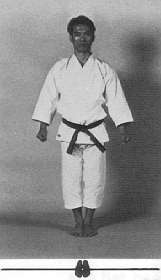 Heisoku-dachi
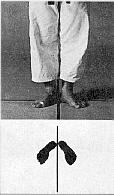 Musubi-dachi
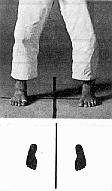 Heiko-dachi
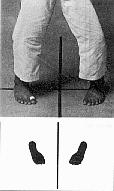 Hachiji-dachi (Shizen-tai)