Greetings in Karate-do — Ritsu-rei and Za-rei Etiquette
Traditional etiquette and bows in Shotokai Karate-do: Ritsu-rei (standing bow from Musubi-dachi) and Za-rei (formal kneeling bow in Seiza). 'Karate begins and ends with courtesy.'
Greetings • Traditional Bows in Karate-do
Shotokai Karate Budo • Technical Descriptions • Etiquette (Rei)
As Master Gichin Funakoshi wrote in the very first principle of his Niju Kun: "Karate-do begins with courtesy and ends with courtesy" (Karate-do wa rei ni hajimari, rei ni owaru koto).
Proper bowing is not mere formality; it is the physical expression of mutual respect, calm mindfulness, and ego-free sincerity between practitioners.
1. Ritsu-Rei • Standing Bow
The standard standing bow executed upon entering and leaving the dojo, when beginning and ending partner practice, and before performing kata.
- Stand in Musubi-dachi (heels together, toes open at approximately 45 degrees).
- Keep the back straight and the arms relaxed at your sides.
- Bend smoothly from the hips at an angle of roughly 15 to 30 degrees, keeping the neck aligned with the spine.
- Lower the gaze naturally without dropping the head, maintaining calm awareness (zanshin).
2. Za-Rei • Kneeling Bow in Seiza
The formal kneeling bow performed during the opening and closing ceremonies of training, as well as before meditation (Mokuso).
- From natural stance, kneel smoothly into Seiza (formal seated posture on the heels, spine upright, knees roughly two fists apart).
- Place the left hand on the floor first, followed immediately by the right hand, with thumb tips and forefingers lightly touching to form an open triangle.
- Bow smoothly from the waist, lowering the forehead toward the hands without raising the hips from the heels.
- Return smoothly upright, lifting the right hand first, then the left, restoring upright posture.
Photographic Reference
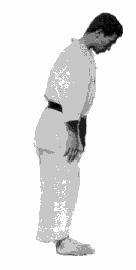 Ritsu-rei • Standing Bow
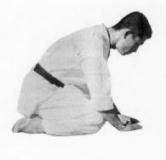 Za-rei • Kneeling Bow (Seiza)